Blog

  • Beetroot

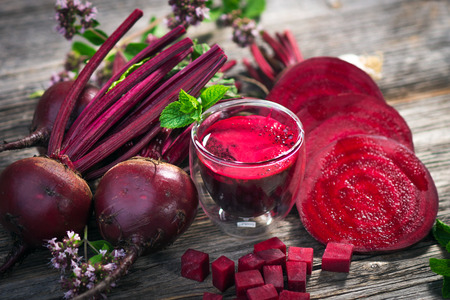
    photo of beetroot whole, sliced, diced and juiced


    What is it?

    Beetroot is the taproot portion of the beet plant, often known as simply the beet. The leaves are also edible, often called beet greens. British beetroot is usually available from July to January, but some may linger on until February or March.  Choose firm beetroot with fresh (unwilted) stalks.

    What to do with it

    The bulbous, dark purple roots are eaten boiled or roasted and sometimes raw in salads. Beetroot juice is also popular. It can also be used to make wine

    Beetroot has made a bit of a comeback recently. It had very bad press for a while. Anyone who experienced typical British cuisine in the 1960s and 70s will remember the pickled abomination which came in jars. Many people were put off beetroot for life because of this. But those who have the courage to try it again minus the industrial pickling process often find they like the rich, sweet, earthy taste.

    I am convinced that my childhood beetroot horror story is shared by countless other unfortunates, and that’s why beetroot isn’t used more often. The other reason could be that it stains everything – if you don’t scrub like a thing possessed, you can end up red-handed for weeks.

    Source: Gregg Wallace, Veg – the greengrocer’s cookbook

    There are other varieties and colours of beetroot but some are relatively rare, eg the golden beetroot.

    To boil beetroot cut off the root tips, leaves and stem but leave a little bit of the stem to prevent the beetroot from bleeding. Bring a large pan of salted water to the boil. Add the beetroot and simmer, uncovered, for about 30 minutes – depending on its size. It’s ready when a fork passes through easily. Drain and let cool a little, then peel and season. (Note, don’t peel the beetroot before boiling or the colour will bleed out.)


  • Avocado

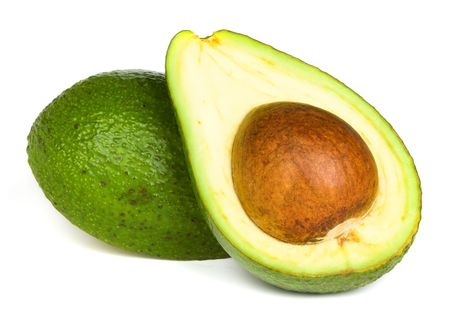
    ripe avocado

    The mild-flavoured avocado pear – these days often shortened to simply ‘avocado’, and sometimes also known as the alligator pear or the butter pear – is technically the fruit of the avocado tree (and unrelated to true pears) but is commonly used as a vegetable. (Sainsburys, who in 1962 were the first supermarket chain to distribute them, soon dropped the ‘pear’ off the name after several customers tried to eat them with custard.)

    There are four main varieties. Hass, which has a dark, knobbly skin, is often considered to be the best. Other varieties include: the pear-shaped, smooth-skinned Ettinger; Fuerte (of which a baby-sized variety is also available); and the more spherical Nabal.

    It’s usually eaten raw although it can be cooked briefly without becoming too bitter. The fruit is native to central America. Mexico is the world’s largest producer of avocados but they are also grown in other places where the climate is suitable, eg in Mediterranean countries. Avocado forms the basis for the popular Mexican dip guacamole.

    Avocados are highly nutritious, containing Vitamin E, potassium, iron and niacin. The avocado is unique among fruit in that it also contains oil – most of it monounsaturated.

  • Watermelon

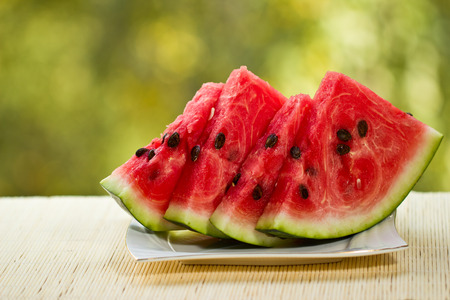
    slices of red watermelon

    Watermelons are large, sometimes stripy, dark green spherical fruits, although there are some other rarer varieties of different coloured rind. The relatively tasteless but refreshing and thirst-quenching flesh is usually crimson, red or pink, but again other varieties are known. They’re members of the gourd family, along with cucumbers, pumpkins and courgettes.

    Jane Grigson is said to have referred to them as “green cannonballs” but generally the fruits are much larger than the average cannonball. They’re more similar in size to a football and can grow up to six kilograms in weight.

    They are thought to have originated in southern Africa and are said to have crossed the Atlantic to the USA on the slave ships. These days they’re grown anywhere the climate is suitable.

    The rind, which has an unpleasant flavour, is sometimes pickled and eaten, especially in the southern US. Watermelons are usually sliced and served raw, either on their own or as part of a fruit or a savoury salad, eg with mint leaves and feta cheese.

  • Paleolithic diet

    Paleolithic diet

    cartoon of cavewoman asking if anyone's got a paleo Christmas recipe
    The Paleolithic diet, often abbreviated to paleo diet, is based mainly on foods presumed to have been available to humans in Paleolithic times. It’s also sometimes called the caveman diet or stone-age diet. People interpret this in a wide variety of ways. Some people pedantically refuse to use modern technology, eg microwave cooking, on the basis that cavemen didn’t have microwaves. However, such purists are rare.

    Most people following the paleo diet eat vegetables, fruits, nuts, roots and meat, ie the food sourced by hunter-gatherers. Later foods, ie those produced by more settled agriculture, are generally avoided. These include dairy products, grains, sugar, legumes, processed oils, salt, alcohol and coffee.

    It’s a controversial diet in as much as today we can only take an educated guess at what cavemen ate but can’t say with any certainty. Additionally, claims to the health benefits of eating like a caveman are disputed too. After all, these people had a much shorter life expectancy than we do today. Also, the digestive abilities of humans today are likely to be different from those of Paleolithic humans, which undermines the diet’s core premise.

    Some argue that although little is known about the diet of Paleolithic humans, it is very likely that they consumed wild grains and legumes. During the 2.6 million-year-long Paleolithic era, the highly variable climate and worldwide spread of human population meant that humans were, by necessity, nutritionally adaptable.

    The paleo diet, in its modern guise, was first developed in the mid-1970s and later popularised by Loren Cordain who published the best-selling book The Paleo Diet in 2002 – and trademarked the term.

    Whilst there may be health benefits to cutting out or down on processed foods, salt and sugar, the British Heart Foundation cautions against rigidly following this or any other fad diet.

    …cutting out dairy products and starchy foods, particularly wholegrains, means losing key sources of fibre, calcium and energy. This could affect your health in the long term. As for weight loss, some people do lose weight on the paleo diet. By cutting out large food groups – especially sugary and processed foods – you’re likely to consume fewer calories (energy), but most fad diets aren’t a long-term solution because they are hard to stick to.

    Instead, make changes that can become everyday habits, while controlling your portion sizes. So, while this diet is a good reminder of foods we need to eat more of, we don’t need to travel back in time to be heart-healthy. The trick is to pick the best elements and enhance these with our modern advantages.

    Nowadays, our meals can be healthy without being restrictive. We can use modern grills, microwaves and non-stick pans to cook food quickly and healthily. We also have access to a wide range of foods, including healthy options like frozen fruit and vegetables, giving year-round variety.

    Source: British Heart Foundation: Is the paleo diet a good way to lose weight?

    As of today, the paleo diet’s popularity continues. However, there is very little scientific evidence either way to prove or disprove that it genuinely does convey the health benefits which are claimed for it.

  • Pak choi and bok choi

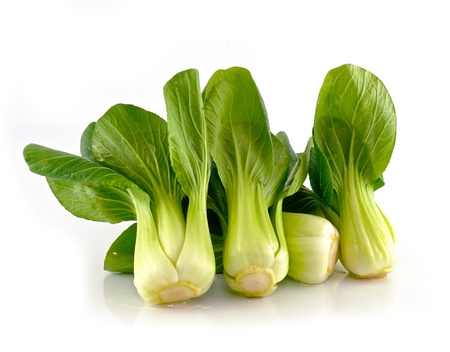
    photo of pak choi

    Pak choi and bok choi are types of Chinese cabbage and sometimes referred to simply as ‘Chinese cabbage’. People often seem to be confused by whether to say “pak” or “bok”.  Are they the same? In terms of texture and flavour, they are pretty much the same. But according to British celebrity greengrocer Gregg Wallace, there is a subtle difference in appearance.

    Pak choi has a white stem and a green leaf, bok choi is green all over. Simple, huh?

    In his book, Veg: the greengrocer’s cookbook, Wallace goes on to say that whilst most people restrict their use of bok choi to wok cooking and Oriental dishes, it’s also very good instead of cabbage in traditional Western meals. It has a lovely crunchy texture and none of the strong green cabbage flavour.

    Bok choi is a brassica, which makes it a member of the cabbage family. If you have never used it, don’t be under any illusion; it tastes as much like a green cabbage as your average penguin. Botanists also tell us that it’s closely related to the turnip. Makes you wonder doesn’t it? How can bok choi be related to a turnip.”

    Source: Gregg Wallace: Veg: the greengrocer’s cookbook

    You can boil, steam or stir fry bok choi – it only takes a few minutes to cook.

    Recipe

    To stir fry pak choi, rip layers from it one at a time, wash it well, chop or not.  Heat a couple of tablespoons of oil in a hot wok. Add pak choi and stir continuously for about three minutes, along with whatever else you fancy, eg vegetables, meat or fish, and noodles.

  • Thai curry paste

    Thai curry paste

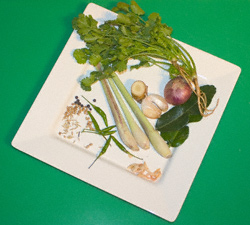
    Photo of typical green curry paste ingredients
    The basis of many Thai dishes, especially curries, is a highly flavoured paste. These pastes are made by grinding the ingredients together, usually in a mortar and pestle, although inferior results can be achieved in a blender.

    The pastes are usually named for their colour, eg green or red curry paste, or for the dish they form the basis of, eg Mussaman paste. They invariably contain a balance of the four taste elements of Thai cuisine: sweet, spicy, salty, sour.

    There are as many different recipes for Thai green curry paste as there are people who make it. There are no hard and fast rules – just a few basic principles and common ingredients. The picture above shows some commonly used ingredients, which were then ground to a paste with a little vegetable oil.

    They include coriander, chillies, shallots, galangal, lemon grass, kaffir lime leaves, coriander seeds, black peppercorns, cumin seeds and dried shrimps.

    The curry itself is likely to contain other flavourings such as nam pla (fish sauce), palm sugar and lime juice to get the balance of flavours right.

    Commercial pastes are widely available and these days many supermarkets also stock jars of Thai curry sauces. But home-made is almost always best.

     Recipe

    Try Not Delia’s green curry paste recipe

  • Abaisse

    This is a term used in French cookery. It means a sheet of rolled-out pastry. Abaisser means to roll out thinly.

    Sometimes the term abaisse is used for a biscuit (cookie) or a slice of sponge cake, which may be spread with cream or jam.

    The word isn’t very commonly used except in the case of French patisserie, so it’s probably not worth making a big effort to commit this one to memory just to expand your vocabulary.

  • Chowder

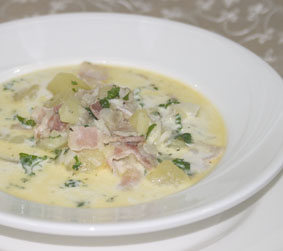
    chowder

    What is it?

    Chowder is stew-like soup with milk or cream, thickened with crackers or potatoes. It’s usually made with seafood or vegetables.

    Famous examples include New England clam chowder and Cullen skink, a Scottish variation of the dish where smoked haddock is used to add flavour.

    Chowder can look a bit special if it’s presented in a bread bowl.

    Recipes

    Not Delia’s bacon, potato, and crab chowder

    Jamie Oliver’s corn chowder

  • Abat-faim

    This is a French culinary term which has become obsolete these days. Literally, abat-faim means “hunger killer” and it was used as a course prior to the main course of a meal to appease the guests’ hunger before starting on the main course.

    These days you’re more likely to be served with hors d’œuvres or appetisers rather than any kind of abat-faim.

    If you’re looking for snacks, starters or tapas, try the Not Delia food blog as there are plenty of good ideas on there.

  • Barigoule

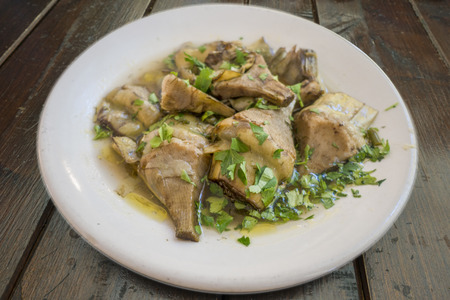
    Barigoule is a traditional Provençal dish of braised artichokes in a warm and slightly tangy white wine broth. It can be made vegetarian by using vegetable stock instead of chicken stock.

    It’s extremely important to plunge the artichokes into iced water with lemon juice as soon as they’re cut. Otherwise they’ll go an unpleasant dark colour.

    See more about preparing globe artichokes.

    Recipe

    New York Times – Artichokes a la barigoule