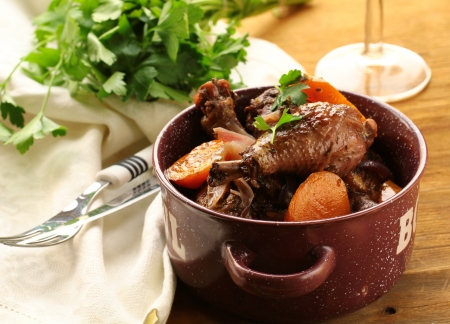
Coq au vin is a French dish of chicken braised with red wine, lardons, mushrooms, and garlic.
Legend has it that Julius Caesar’s cook created the first coq au vin recipe after the Gauls gave Caesar a tough old cockerel as tribute for his conquering them. Caesar’s cook made the bird into a delicious meal to serve back to the Gauls. It’s an interesting story but it’s more likely that the dish evolved previously without any input from Caesar.
The term coq au vin is French for “cockerel with wine” and was probably a common peasant dish in previous centuries. Rural families in France commonly kept chickens and a cockerel. The cockerel would be kept until it was too old to perform its duties, and would then be eaten. Old birds, however, were tough and stringy, so the common preparation was to slow-simmer it in wine in order to tenderise the meat and make it more palatable.
These days it’s usually made with chicken rather than an old cockerel, but if you’re friendly with your local butcher and want to try an authentic recipe you could ask if s/he could order an old bird for you.
Foie gras (French: ‘fatty liver’) is a luxury food that seriously divides opinions. It’s hard to think of any more controversial dish that you can eat without breaking the law (but we’ll come back to that below).
Gourmets prize it as the last word in richness and subtlety of flavour. Animal rights activists condemn the barbaric and grotesque manner of its production. Let’s set aside the hype and look at the facts.
Put simply, foie gras is the liver of ducks or geese that have been specially fattened. However, the words ‘specially fattened’ are a bit of a euphemism; the traditional method of fattening (gavage) involves force-feeding the bird through a tube with corn boiled up with fat. This process is carried on for two or three weeks before the bird is slaughtered.
Source: Not Delia: Is foie gras cruel?
Despite the controversy over the production method it’s still a highly sought-after delicacy because of its unique creamy, silky texture and flavour. Goose is usually considered to have a better flavour and a finer texture than duck liver and is the more expensive of the two.
It can be bought whole and raw in lobes, semi-cooked (mi-cuit) or cooked in a paté or mousse.
The production of foie gras is banned in the UK, but as its import or sale is not prohibited it is still possible to buy it from some suppliers, eg Fortnum & Mason. The production is also banned in Australia, several European countries, Argentina, Brazil, Israel, and several US States. In July 2014, India banned the import of foie gras, making it the first and so far only country in the world to do so, causing dismay among some of the nation’s chefs.
Top chef Anthony Bourdain has been a staunch defender of foie gras ever since it was banned in California.
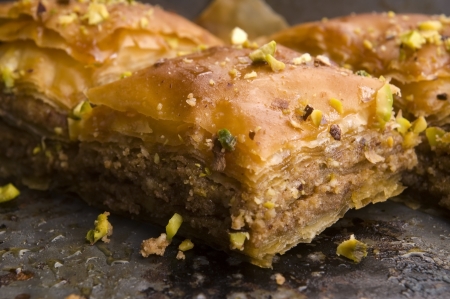
Originally from Turkey, baklava is a rich, sticky, sweet pastry made from layers of filo pastry, filled with chopped nuts, and sweetened and held together with syrup or honey.
It’s best to score the pastry prior to baking, as it will be very difficult to cut neatly after it’s been baked.