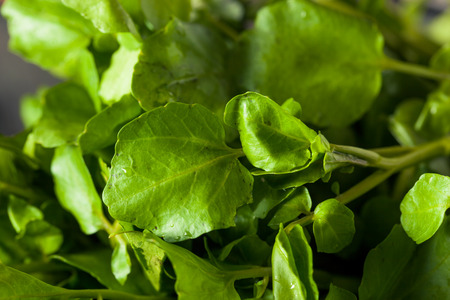
Watercress is a close relative of the nasturtium and also related to mustard. It’s cultivated for its green, peppery-tasting leaves. It’s commonly used in salads or in soup. It makes a nice edible garnish too.
Watercress is a close relative of the nasturtium and also related to mustard. It’s cultivated for its green, peppery-tasting leaves. It’s commonly used in salads or in soup. It makes a nice edible garnish too.
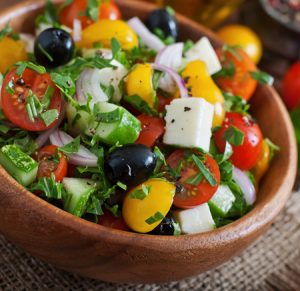
Greek salad is a fresh and simple salad consisting of tomatoes, cucumber, olives and feta cheese, often enhanced with various herbs.
In Greece it’s called khōriattikisalata, which means ‘country-Attic salad’; it’s named after Attica, an area encompassing Athens.

Gravadlax, also known as gravlax, is a Scandinavian dish consisting of fresh, raw salmon fillet marinated with salt, sugar and dill. Once cured, it’s sliced thinly. It originated as a means to preserve fish in the days before refrigeration. The fish was prepared with salt and dill and then buried in the ground. (‘Grav’ is Swedish for ‘grave’ or ‘pit’. ‘Lax’ is Swedish for ‘salmon’.)
These days it can easily be made at home in the fridge. Using beetroot in the cure has become fashionable and gives the salmon an interesting colour. The Not Delia website has a delicious take on this using a fresh orange, honey and soy sauce.

A bhaji, sometimes called ‘bhajia’, is an Indian snack. It’s a vegetable fritter. For example, you could have cauliflower bhajis, aubergine bhajis or, the most common in British Indian cuisine, onion bhajis.
The word ‘bhaji’ is Hindi for ‘vegetable’.
It’s easy to make by slicing the vegetables and coating them in a batter of gram flour and spices, then deep frying.
Bhajis are usually served with a dip as part of an Indian meal or a starter.
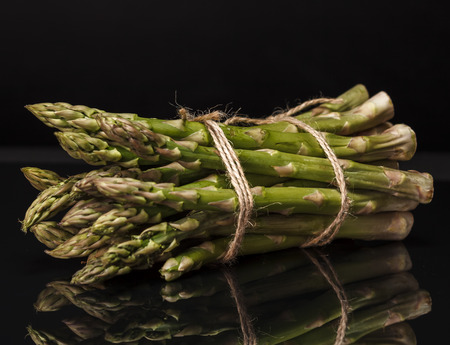
Asparagus, a herbaceous perennial plant, is generally considered to be a luxury vegetable. Quite simply, it’s expensive to buy because it’s expensive to cultivate. A newly planted asparagus plant takes three years to produce spears that are good enough to sell. Then it will only produce spears for a further three years. Therefore, a typical asparagus field will only give a yield for half of the time. Additionally, asparagus requires a lot of land as each square foot will only produce about one spear. And then these spears have to be harvested manually as there’s yet no way to harvest them mechanically.
Asparagus is graded by size, the ‘sprue’ being the slimmest and ‘jumbo’ the thickest.
Most countries eat white asparagus and this is even more expensive to cultivate as the spear must be shielded from the light.
White asparagus is a peculiar thing. I think so, but then I’m in a minority. I’m used to the green stuff, and I find white asparagus low in both texture and flavour. It is only in Britain, Italy and parts of the USA that eat their asparagus green. The rest of the world, and that includes most of Europe, eats it white. To keep it white, you have to build up the soil around it as it grows, keeping it underground and out of the light. You prepare the white as you do the green.
Source: Gregg Wallace: Veg – the greengrocer’s cookbook
Asparagus is a spring vegetable, and available in Britain from about May to July. Imports are available all year round but many people consider that locally grown veg tastes better than any which have flown half-way round the world.
Asparagus which is limp is past its best; the spears should be firm with smooth skin, and the heads (what some call tips) tightly closed. Asparagus requires very little cooking – the simpler the better – just boil, steam or griddle. It can also be eaten raw but cooked briefly is better.

The water chestnut (sometimes called Chinese chestnut) is not a nut at all. It’s an aquatic vegetable that grows, under water, in marshes. It’s native to Asia, and is grown in many countries for its edible corms (swollen underground plant stems, like tubers).
Most of us in the West will only ever have seen the tinned version of these, which is readily available in supermarkets. And if you’ve eaten water chestnuts in Britain, it’s likely to have been in a Chinese restaurant.
The crunchy, white flesh of the small, rounded corms is good sliced up in Chinese food as it adds a nice texture to the dish. They’re most often steamed or stir-fried and served in dishes with rice or noodles.
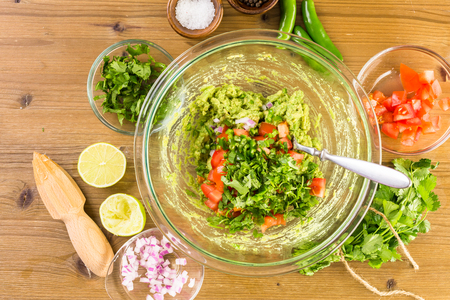
Guacamole is an avocado-based dip or salad. It was first created by the Aztecs in what is now Mexico. As well as its use in modern Mexican cuisine, it’s widely eaten throughout the UK, North America and Australia and other countries. Israel, where avocados are widely grown, has its own version called ‘salat avocado’.
Traditionally guacamole – which means avocado sauce – is made by mashing ripe avocados with sea salt in a mortar and pestle. Additional ingredients such as tomato, onion, garlic, chilli, coriander (cilantro) and lime juice are often added.
These days commercially prepared guacamole is easily available from supermarkets thanks to packaging and processes which extend its shelf life.
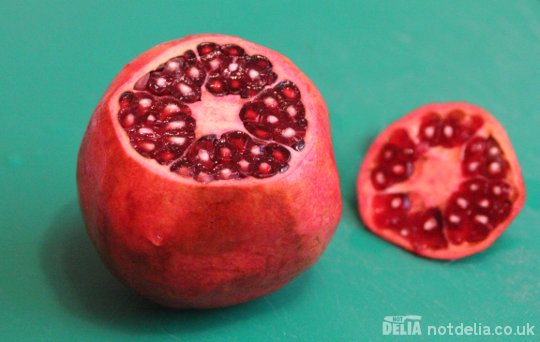
Pomegranates originate from Persia, but are now mainly grown in Spain, the Middle East, and America. They’re round, about the size of an apple, with a hard, shiny, red skin, which is inedible. Inside the fruit you’ll find countless little edible seeds, each of which is contained in a jewel-like sac of sweet juice. The sacs are packaged in a bitter, inedible pith so to prepare the pomegranate you’ll need to get rid of the pith.
Pomegranate is mostly used in salads, especially in the Middle East, or as a garnish to decorate meat dishes. Alternatively, you could eat it straight from the shell using a cocktail stick to extract the juice sacs. It’s considered by some to be a ‘superfood’ as it’s highly nutritious.
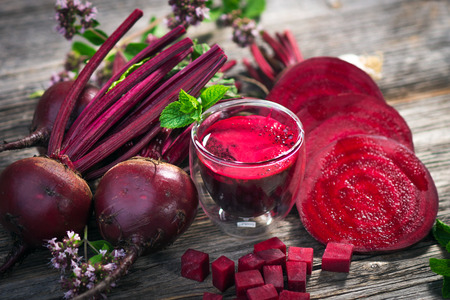
Beetroot is the taproot portion of the beet plant, often known as simply the beet. The leaves are also edible, often called beet greens. British beetroot is usually available from July to January, but some may linger on until February or March. Choose firm beetroot with fresh (unwilted) stalks.
The bulbous, dark purple roots are eaten boiled or roasted and sometimes raw in salads. Beetroot juice is also popular. It can also be used to make wine
Beetroot has made a bit of a comeback recently. It had very bad press for a while. Anyone who experienced typical British cuisine in the 1960s and 70s will remember the pickled abomination which came in jars. Many people were put off beetroot for life because of this. But those who have the courage to try it again minus the industrial pickling process often find they like the rich, sweet, earthy taste.
I am convinced that my childhood beetroot horror story is shared by countless other unfortunates, and that’s why beetroot isn’t used more often. The other reason could be that it stains everything – if you don’t scrub like a thing possessed, you can end up red-handed for weeks.
Source: Gregg Wallace, Veg – the greengrocer’s cookbook
There are other varieties and colours of beetroot but some are relatively rare, eg the golden beetroot.
To boil beetroot cut off the root tips, leaves and stem but leave a little bit of the stem to prevent the beetroot from bleeding. Bring a large pan of salted water to the boil. Add the beetroot and simmer, uncovered, for about 30 minutes – depending on its size. It’s ready when a fork passes through easily. Drain and let cool a little, then peel and season. (Note, don’t peel the beetroot before boiling or the colour will bleed out.)
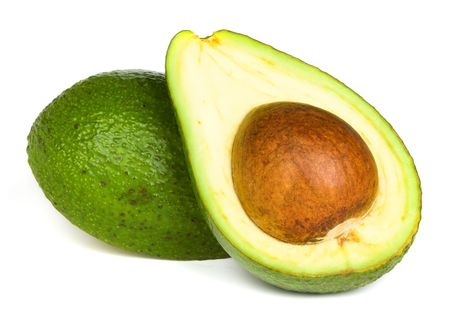
The mild-flavoured avocado pear – these days often shortened to simply ‘avocado’, and sometimes also known as the alligator pear or the butter pear – is technically the fruit of the avocado tree (and unrelated to true pears) but is commonly used as a vegetable. (Sainsburys, who in 1962 were the first supermarket chain to distribute them, soon dropped the ‘pear’ off the name after several customers tried to eat them with custard.)
There are four main varieties. Hass, which has a dark, knobbly skin, is often considered to be the best. Other varieties include: the pear-shaped, smooth-skinned Ettinger; Fuerte (of which a baby-sized variety is also available); and the more spherical Nabal.
It’s usually eaten raw although it can be cooked briefly without becoming too bitter. The fruit is native to central America. Mexico is the world’s largest producer of avocados but they are also grown in other places where the climate is suitable, eg in Mediterranean countries. Avocado forms the basis for the popular Mexican dip guacamole.
Avocados are highly nutritious, containing Vitamin E, potassium, iron and niacin. The avocado is unique among fruit in that it also contains oil – most of it monounsaturated.