Tag: Italian cuisine

  • Balsamic vinegar

    Olive oil and balsamic vinegar with bread
    Olive oil and balsamic vinegar with bread

    True Balsamic vinegar is an artisan product from Modena, in Italy.  It’s made from grape juice, which is simmered to make a concentrate, and then fermented. Finally it’s matured in barrels for a minimum of 12 years. The barrels used are made from different woods to impart different flavours. The result is a rich, dark and syrupy vinegar, which should be used sparingly – not least because it’s expensive.  The real thing will be labelled ‘tradizionale’ and/or marked DOC.

    It’s possible to buy cheaper balsamic vinegar. This is made industrially from vinegar and grape juice and is called ‘aceto balsamico di Modena’. This vinegar does not undergo the same ageing process as the artisan product and the flavour is inferior and weaker – but it’s fine for salad dressings and the like.

    A typical Italian starter or side dish consists of bread served with balsamic vinegar and olive oil. Balsamic vinegar also marries well with fruit, particularly strawberries.

    More information

    See also Vinegar for more details about how vinegar is made.


  • Lasagne

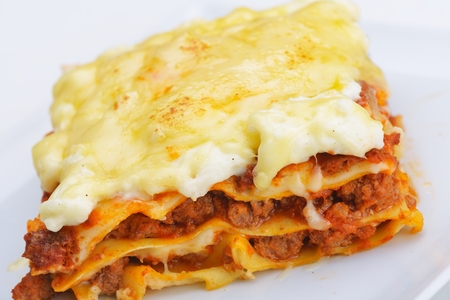
    Lasagne

    photo of traditional lasagne
    Traditional lasagne made with bolognese sauce

    The word ‘lasagna’ is originally from the Greek word for ‘chamber pot’. The Romans then borrowed the word applying it as ‘cooking pot’. Perhaps you had to be there to get the joke. Later, the Italians adapted the word to mean a particular dish cooked in such a pot, and that is what we now know as lasagne.

    It consists of flat sheets of pasta layered with béchamel sauce, a meat and tomato sauce, and topped with Parmesan cheese.

    Lasagne verdi, or green lasagne, is lasagne sheets flavoured and coloured with spinach.

    Recipe

    Try Theo Randall’s lasagne recipe

  • Amaretto

    amaretto liqueur with amaretti biscuits and shelled almonds

    Amaretto is a sweet, almond-flavoured liqueur which originates from Saronno, Italy. There are several commercial brands available notably Disaronno and Lazzaroni.

    It can be drunk on its own, with ice, in coffee or used as a cocktail base. It’s also used for various culinary purposes, to add flavour to both sweet and savoury dishes.

    At Christmas it’s often served with panettone, a type of Italian sweet bread.

    The word amaretto is a derivative of the Italian amaro, meaning ‘bitter’, because of the bitter almonds which are its main flavouring ingredient. Amaretti are similarly flavoured sweet little biscuits, like small macaroons. They are often purchased in individual tissue paper wrappings, although they can also be made at home.

  • Panettone

    photo of Christmas panettone on the left and stollen on the right

    Panettone is a type of sweet bread loaf which originated in Milan, Italy. It’s often found at Christmas, New Year and other celebrations in Southern Europe and Latin America.

    It’s pictured on the left above, with stollen on the right.

    Panettone takes a long time to make as the dough is cured, in a process similar to that for making sourdough bread. The proving takes several days. Traditionally, the cake contains contains candied citrus fruit such as oranges and lemons as well as dry (not soaked) raisins.

    It’s typically served in wedges with a sweet hot drink or a sweet wine or liqueur, eg amaretto.

    Recipe

    BBC Good Food’s Panettone

  • Ciabatta

    crusty homemade Italian ciabatta bread

    Ciabatta is a type of Italian white bread which includes olive oil as one of its ingredients.  It was first created in Verona in response to the popularity of the French baguette. Literally, the name means ‘slipper’ as it was named by Francesco Favaron, the original baker, who thought its shape looked like his wife’s slippers.

    Toasted sandwiches made from small ciabatta loaves are called panini.

    Since its original invention in the 1960s, many new variations have been developed, including a wholemeal version known as ciabatta integrale.

  • Gorgonzola

    a wedge of gorgonzola cheese

    Gorgonzola is a sharp-flavoured, blue-veined, creamy cheese which is named after the Italian village near Milan from where it originates.

    It’s made from unpasteurised cows milk and injected with greenish-blue mould which gives a lovely sharp contrast to the creamy cheese. It’s often found as a dessert cheese and is a cheeseboard favourite. It can also be crumbled onto pasta or risotto and used in salads and dressings.

  • Vinegar

    various bottles of oils and vinegars

    Vinegar literally means ‘sour wine’ and it was originally produced by the acetic fermentation of wine.  Whilst there is some evidence that it existed in Britain in pre-Roman times, it was the Romans who introduced it more fully. The Romans were very keen on it as a condiment, for cooking and even – well watered down – as a drink.

    When wine was not available, vinegar was made from other ingredients, such as ale. This is the origin of malt vinegar, which is so popular in Britain especially on fish and chips. This is unsurprising in a country without lemons.

    Despite the ubiquity of malt vinegar in Britain, in recent decades there has been a greater interest in a wider variety of wine vinegars, including those flavoured with herbs and spices.

    These days the most common culinary uses of vinegar is as a cooking ingredient (eg for vinaigrette), for pickling, and as a condiment.

    In addition to its culinary uses, vinegar has also had various other roles to play in industry, medicine and the household, such as for cleaning and disinfecting.

    More information

    See also Balsamic Vinegar for more details about the artisan vinegar from Modena, Italy.

  • Vermouth

    Photo of Italian red and white vermouth

    Vermouth is an alcoholic drink made from a red or white wine base infused with any of a wide variety of aromatic herbs. It’s mostly used as a basis for cocktails. Its name comes from one herb in particular – wormwood.

    Vermouth is produced in the foothills of the Alps on both the French and Italian sides, where the necessary herbs are readily available.

    The commonest French vermouth is a dry white version, as used to make ‘dry Martini’ cocktails. Italian vermouth, by contrast, is mostly sweet. Both white and red (bianco and rosso) are made. The red vermouth is a key ingredient in the cocktail ‘Manhattan’.

    The most famous producers of vermouth include Martini, Rossi and Cinzano.

  • Zabov all’uovo

    zabov all'uovo

    Zabov all’uovo is a traditional Italian eggnog made with milk, fresh egg yolks, sugar, and a little alcohol (it’s only 15% ABV). It has a brandy flavour. It’s a sweet, energising liqueur, taken warm as a tonic, or any time for a celebration. It is also sometimes used as a complement for gourmet desserts.

    In 1946 a young merchant from Ferrara, driven by a passion for novelty, courageously decided to abandon the tranquillity of his family’s own business to undertake an entrepreneurial project and set up Distillerie A.R.P.A. di Mauro Moccia sas, a company “to produce and sell liqueurs, syrups and related products”.

    From March 2011 this ferrarese liquor was added to the official list of traditional products of the Emilia-Romagna region.

    Source: Ferrara: Terra e Acqua: Zabov – Zabaglione Egg Liquor

    It’s the Italian version of the better-known Dutch advocaat.