Tag: British cuisine

  • Sausage rolls

    Cocktail sausage rolls for Burns Night
    Cocktail sausage rolls for Burns Night

    A sausage roll is a savoury pastry snack which is popular in Britain and in the Commonwealth nations.  They’re commonly sold in retail outlets such as supermarkets and bakeries.  The mini, or cocktail, versions are often served hot or cold as buffet or party food.

    A sausage roll consists of a tube of sausage meat enclosed in puff pastry and baked.

    More information

    Not Delia makes cocktail sausage rolls

    Recipe

    John Torode’s sausage rolls


  • Lamb’s wool

    Lamb’s wool is a traditional English drink which was popular from the 16th to the 19th centuries. It consisted of beer, heated, sweetened and spiced. Then the soft, fluffy pulp of baked apples was mixed in – presumably leading to the drink being so-named.

    Samuel Pepys mentioned the drink in his diary on 9 November 1666:

    Being come home, we to Cards until two in the morning; and drinking lamb’s wool, to bed.

  • Maid of honour

    Photo of maids of honour tarts
    Maids of honour tarts

    Maids of honour are small almond-flavoured custard tarts, traditionally made with a lemon curd and cream cheese filling.  It’s said that Anne Boleyn invented them whilst she was lady in waiting to Catherine of Aragon and Henry VIII liked them so much he named them maids of honour after the Queen’s unmarried attendants.

    Recipe

    Asda Good Living Maids of Honour

  • Marmite

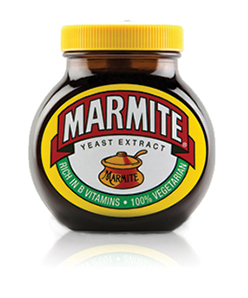
    Marmite

    The original use of the word marmite was for a French two-handled earthenware or metal cooking pot, used for makings soups and stews. It’s thought that the term was derived from the old French word for ‘hypocrite’ – the idea being that the pot was a hypocrite because it concealed its contents.

    Later in Britain the word was used for a proprietary brand of a spread made from yeast extract, a by-product of the beer brewing industry. The paste is dark, sticky, and very salty. It’s often spread on toast but can also be used for various other purposes, eg to add a tasty stock to vegetarian dishes.

    The Marmite familiar to many Brits today was originally launched in 1902 and depicts a marmite pot on its label. There have also been many special editions to celebrate various events, eg a special edition called ‘Ma’amite’ was released in April 2012 to commemorate the Diamond Jubilee of Queen Elizabeth II.

    More information

    Visit the official Marmite website.

  • White meat and dark meat

    White meat and dark meat

    cartoon of two lions with a dead zebra - "white meat or dark?"

    White meat

    In earlier times ‘white meat’ was simply a term for dairy products, eg milk, butter, cheese, and sometimes eggs. However, in modern English white meat has two meanings. The main one refers to cooked breast meat and other pale-coloured cooked meat of poultry, as opposed to the darker meat of the other parts, such as the legs.

    It’s thought that this usage was initially adopted as a euphemism in the 19th century (Victorian times) by those too refined to use the word ‘breast’ in polite company.

    The other modern use of the term ‘white meat’ is to refer to pale-coloured meat in general, especially chicken and turkey, but also pork, rabbit, etc – as opposed to the red meats of beef, lamb, venison, etc.

    Dark meat

    Dark meat refers to the cooked meat from the legs of poultry, in particular chicken and turkey. As with white meat, the term seems to have been adopted in Victorian times as a euphemism to save the sensibilities of those too genteel to mention ‘leg’ – or worse still – ‘thigh’.

    Drumstick

    The word drumstick for chicken legs appears to have been coined earlier. According to John Ayto in An A-Z of Food and Drink, “The first known reference to poultry thighs as ‘drumsticks’ comes in the Mayor of Garret (1764), a play by the now almost forgotten dramatist Samuel Foote… They get their name, of course, from their shape, bulbous at one end with the bone protruding sticklike at the other.”

    Joint

    The word ‘joint’ is, in some cases, a similar euphemism for dark meat. In Britain, at least since the 16th century, a joint simply meant a large piece of meat for roasting. However, in 19th century America it meant something different. Given the Victorian-induced taboo of mentioning body parts such as ‘legs’, it was necessary to give these parts an alternative name. Thus the legs of poultry were referred to as joints. John Ayto (see above) writes: “Apparently it caused a certain amount of confusion among British visitors.”

  • Bakewell tart

    photo of traditional bakewell tarts

    A Bakewell tart is a confection originating from Bakewell, a town in Derbyshire, England. Historically, it was served at any holiday occasion. Nowadays one could eat them on any day, usually with a cup of tea. Commercial versions are easily available.

    The tart consists of a shortcrust pastry shell, topped with a layer of jam, another of frangipane, and a topping of flaked almonds. The tart itself could be a large round, or a tray bake, which is then sliced into portions, or – as shown above – made into little, cup-cake-sized portions.

    The Bakewell pudding predates the Bakewell tart and the latter is thought to be a 20th century alteration.  The Bakewell pudding has a flaky pastry shell according to Mrs Beeton, although the pudding’s earliest record, by Elizabeth Acton in 1845, makes no mention of pastry.

    Recipe

    Felicity Cloake’s perfect Bakewell tart

  • Brussels sprouts

    photo of Brussels sprouts in a snowy field

    What are they?

    Brussels sprouts are like miniature cabbages which grow in multiple rows on a thick central stalk.

    The sprout is obviously a brassica, but it’s anybody’s guess when somebody mutated it from its original cabbage. I believe sprouts originated in Belgium, where they were sold in markets as early as the 13th century (they didn’t appear in England or France until the end of the 18th century). But most Belgians believe sprouts to be Italian in origin. We know that sprouts were mentioned in Belgian market regulations in 1213. The earliest French record I can find is an order for a wedding feast of the Burgundian court in the 15th century. We have no English recipes until the 19th century.

    Source: Gregg Wallace, Veg – the greengrocer’s cookbook

    What to do with them

    Many people associate Brussels sprouts with Christmas, it’s certainly a winter veg. They’re best between October and March in the UK. Many people, especially children, dislike sprouts because of their bitter taste. Perhaps this explains the British tradition of boiling them to death. It’s sometimes joked that October is the time to put the sprouts on to boil for Christmas. It’s fair to say that they’re an acquired taste. However, modern varieties have been bred to reduce the bitterness, and are often sweet and nutty, so if you have unhappy memories of eating sprouts as a child, it might be worth your while to give them another try.

    Another traditional British thing was to cut a cross in the base of the sprout. This will also lead to a mushy sprout. Instead cut the larger ones in half vertically.  Sprouts should ideally be served with a bit of bite still in them. Three or four minutes boiling should suffice. Serve with a knob of butter.

    The tops of the plants can also be eaten. They’re just like cabbage leaves after all –  cook them as you would spring greens.

    Recipe

    Christmas dinner made easy

  • Beetroot

    photo of beetroot whole, sliced, diced and juiced


    What is it?

    Beetroot is the taproot portion of the beet plant, often known as simply the beet. The leaves are also edible, often called beet greens. British beetroot is usually available from July to January, but some may linger on until February or March.  Choose firm beetroot with fresh (unwilted) stalks.

    What to do with it

    The bulbous, dark purple roots are eaten boiled or roasted and sometimes raw in salads. Beetroot juice is also popular. It can also be used to make wine

    Beetroot has made a bit of a comeback recently. It had very bad press for a while. Anyone who experienced typical British cuisine in the 1960s and 70s will remember the pickled abomination which came in jars. Many people were put off beetroot for life because of this. But those who have the courage to try it again minus the industrial pickling process often find they like the rich, sweet, earthy taste.

    I am convinced that my childhood beetroot horror story is shared by countless other unfortunates, and that’s why beetroot isn’t used more often. The other reason could be that it stains everything – if you don’t scrub like a thing possessed, you can end up red-handed for weeks.

    Source: Gregg Wallace, Veg – the greengrocer’s cookbook

    There are other varieties and colours of beetroot but some are relatively rare, eg the golden beetroot.

    To boil beetroot cut off the root tips, leaves and stem but leave a little bit of the stem to prevent the beetroot from bleeding. Bring a large pan of salted water to the boil. Add the beetroot and simmer, uncovered, for about 30 minutes – depending on its size. It’s ready when a fork passes through easily. Drain and let cool a little, then peel and season. (Note, don’t peel the beetroot before boiling or the colour will bleed out.)